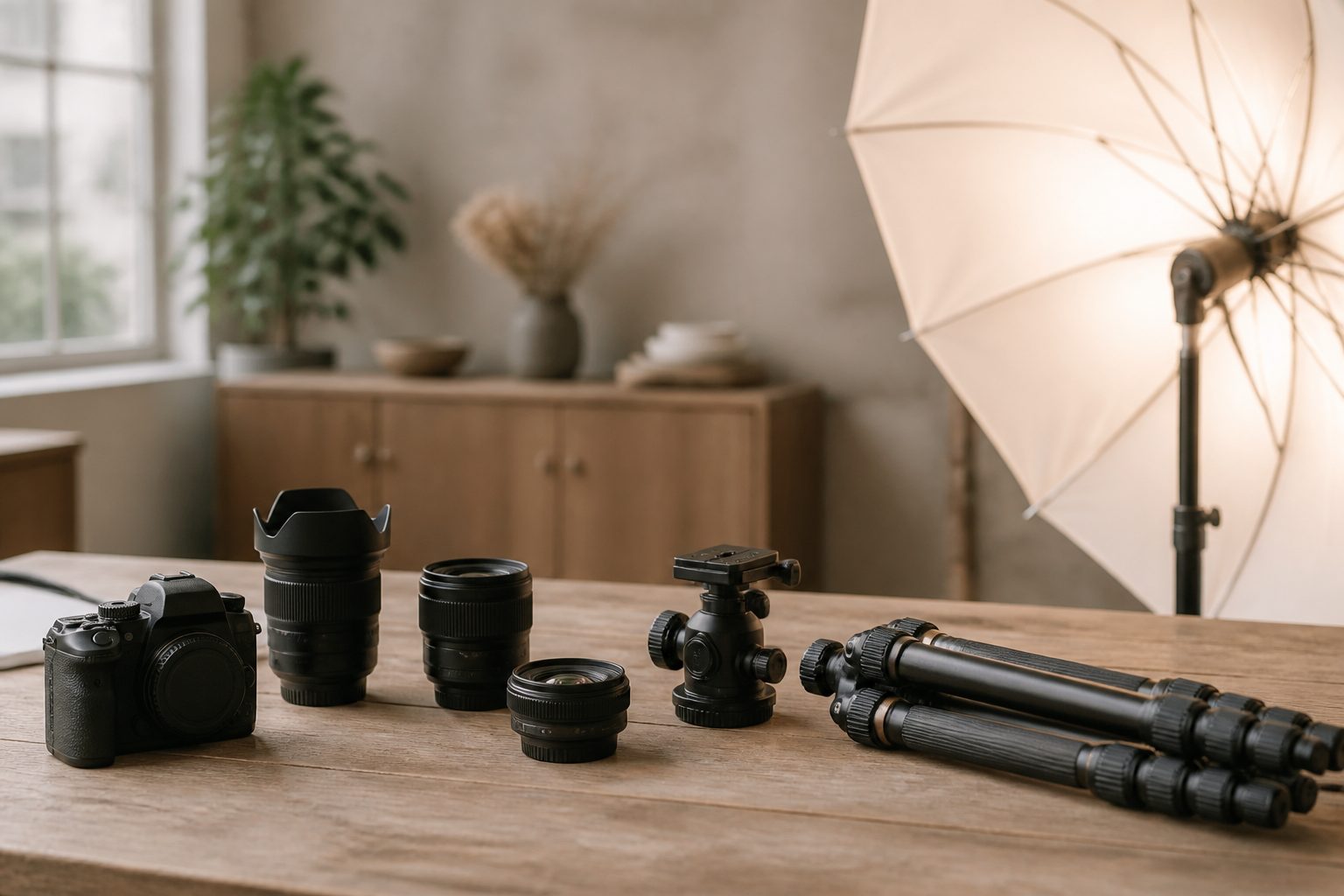
If your team is going to shoot some content in-house, the gear question comes up fast — and the marketing around photography equipment is designed to make you spend more than you need. The truth is that the right kit depends entirely on what you’re shooting, and beyond a sensible baseline, technique matters far more than the price of the camera. This no-jargon guide explains what each piece of equipment actually does, what’s worth buying for in-house brand content, and where the line is that means you should hire a professional instead.
The camera matters less than you think
People obsess over the camera body, but for most brand content it’s the least decisive choice. Modern cameras — including recent smartphones — are remarkably capable. What you’re really paying for as you go up the range is flexibility in difficult conditions, not “better photos” in good light.
- Smartphone — genuinely good for casual social content, behind-the-scenes and quick lifestyle shots, especially in decent light.
- Mirrorless / DSLR — the step up that matters when you need control, interchangeable lenses, low-light performance and reliable consistency across a big set.
For most in-house needs, a mid-range mirrorless camera is far more than enough. Spending up to a flagship body rarely changes results for typical brand work — the budget is better spent elsewhere.
Lenses do more for your image than the body
If you’re going to invest, invest here. The lens shapes perspective, sharpness and that pleasing background blur far more than the camera does.
- A standard prime (around 50mm) — sharp, flattering, great for products and portraits, and usually affordable.
- A macro lens — essential for close detail: jewellery, watches, textures, small products.
- A wider lens — for interiors and spaces, to fit a room in without distortion (avoid going too wide, which warps).
- A versatile zoom — convenient when you can’t keep changing lenses, e.g. events.
One good lens matched to your subject beats an expensive body with a mediocre kit lens every time.
Lighting is where in-house content usually wins or loses
As covered in our lighting guide, light is the biggest factor in how professional an image looks — and it’s where a little equipment goes a long way.
- A reflector / white foam board — the cheapest, highest-impact item you can own, bouncing light into shadows.
- A diffuser — softens harsh sun or a hard lamp into flattering light.
- A continuous LED light with a softbox — affordable, easy to learn (what you see is what you get), and covers a huge range of product and portrait work.
- Strobes / flash — more power and freezing ability, but a steeper learning curve; usually pro territory.
For in-house content, a single softboxed LED plus a reflector handles more than most teams expect — and consistent, controllable light is exactly what separates usable content from “why does this look amateur?”.
The supporting kit that quietly matters
Unglamorous but genuinely useful photography equipment:
- A tripod — keeps shots sharp, lets you maintain identical framing across a product set, and is essential for consistent catalogue work.
- A backdrop or seamless paper — clean, repeatable backgrounds for product shots.
- Surfaces and props — boards, fabrics and styling pieces for lifestyle scenes.
- Spare batteries and memory cards — boring until the one time they save a shoot.
- A grey/white card — for accurate, consistent colour across a set.
A tripod and a backdrop, in particular, are what make in-house catalogue images look consistent rather than randomly framed.
What to buy for in-house content
If you want a sensible starting kit for everyday brand content, this covers most needs without overspending:
- A mid-range mirrorless camera (or a good phone to start).
- One sharp standard lens, plus a macro if you shoot small detailed products.
- A continuous LED with softbox, plus a reflector and diffuser.
- A tripod and a simple backdrop.
That setup, with someone who’s learned the basics of light and composition, produces solid social and supporting content. Notice the pattern: the spend skews toward light and lenses, not the camera body.
When equipment isn’t the answer — hire a pro
Gear has limits, and some jobs need expertise and specialised kit that’s rarely worth buying for occasional use. Hire a professional when:
- You need hero images and campaign work where quality is mission-critical.
- The subject is technically hard — reflective products, jewellery, glassware, large interiors, food.
- You need consistency across a large catalogue shot after shot.
- The cost of a reshoot or off-brand images outweighs the saving of doing it yourself.
A practical model many brands use: handle casual, high-frequency social content in-house, and bring in our photography and content team for the load-bearing imagery — products, campaigns and anything customers scrutinise. You can see the kind of result that justifies the professional route across our portfolio.
Frequently asked questions
What photography equipment do I need to start shooting brand content in-house?
A mid-range mirrorless camera (or a good phone to begin), one sharp standard lens plus a macro if you shoot small detailed products, a softboxed LED light with a reflector and diffuser, and a tripod with a simple backdrop. Spend on light and lenses before the camera body.
Is a more expensive camera worth it for brand photography?
Usually not for typical brand content. Modern mid-range cameras and even phones are very capable in good light. The bigger gains come from better lenses, controlled lighting and technique — not from buying a flagship body.
When should I stop buying gear and just hire a photographer?
When the work is mission-critical (hero and campaign images), technically demanding (reflective products, jewellery, food, large interiors), or needs consistency across a big catalogue. At that point, professional expertise and specialised kit deliver more value than anything you’d buy for occasional use.
Not sure what to do in-house and what to outsource? Tell us about your content needs and we’ll help you draw the line sensibly.