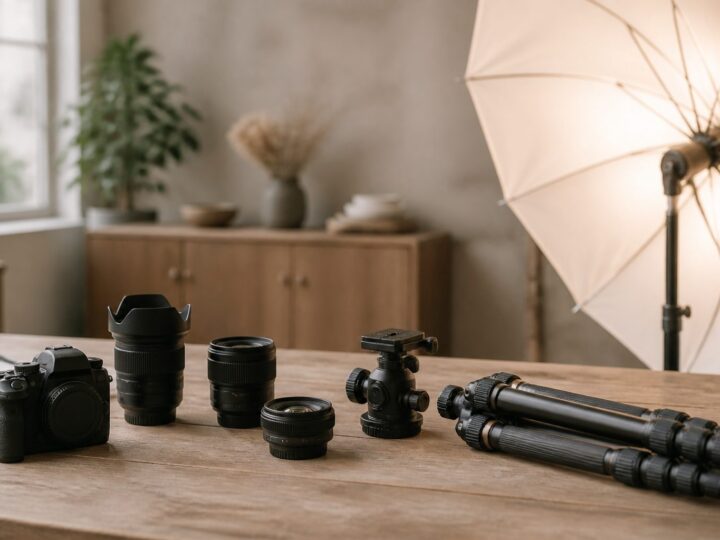
Studio photography is the most controlled way to make an image. Inside four walls with the lights you choose, nothing is left to weather, time of day or a passing crowd — you set the light, lock the camera and shoot until it is exactly right. That control is the whole point, and it is also why studio is not always the answer. This guide explains how a studio shoot actually works, when it earns its keep over shooting on location, and how to brief one so you get a consistent set of images rather than a folder of near-misses.
What “studio” actually buys you
The defining feature of studio photography is full command of the light. Instead of waiting for the sun, you shape it with strobes and modifiers — softboxes for a broad, flattering wrap, beauty dishes for crisp portrait light, grids and snoots to control spill, reflectors to lift shadows. You decide the direction, hardness and ratio of every light in the frame, and it stays put for the whole session.
That repeatability is the real value. When you photograph forty products over two days, the seventh shot needs to match the thirty-seventh. Lock the lights, lock the exposure, lock the camera on a tripod, and every frame sits in the same world. Try that outdoors and the light shifts every twenty minutes.
A studio also gives you a clean canvas: seamless paper rolls, a painted cyclorama wall for that horizon-free infinite background, or a sweep for products. You isolate the subject from any context you do not want, which is exactly what an e-commerce catalogue or a clean headshot needs.
Tethered shooting and why it matters
Most serious studio photography is shot tethered — the camera runs by cable or wireless straight to a laptop or large screen. Every frame appears full-size in seconds, so you and the client can check focus, fit, reflections and styling before you move on, not days later when the model and the set are gone.
Tethering is what makes a studio session efficient rather than just controlled. You approve as you go, the art director adjusts a fold or a label between frames, and you leave knowing the set is complete. For catalogue and product work this single habit prevents most expensive reshoots.
When studio beats location
Reach for studio photography when consistency and control are the priority:
- Product catalogues. Dozens or hundreds of SKUs that must match in scale, angle and background. A controlled set is the only sane way to keep them uniform.
- White-background e-commerce. Marketplace listings demand a clean, even, shadow-controlled look that a studio delivers every time.
- Corporate headshots and team portraits. When everyone in the company needs to match — same light, same background, same crop — even if they are photographed months apart.
- Anything precise. Jewellery, cosmetics, watches, food on a set — work where you need to chase down a single reflection or a stray highlight without the world moving around you.
- Tight deadlines and bad weather. A studio does not care that it is monsoon season. The light is the same at 9am or 9pm.
When it doesn’t — choose location instead
Studio is not automatically the premium choice. It removes context, and sometimes context is the message. If you need to show a product genuinely in use, a team in their real workspace, a venue’s atmosphere, or a lifestyle feel that says “this is real life”, a clean sweep will look sterile. That is when a location shoot wins, and it is a different craft with its own logistics. Many brands end up doing both — studio for the clean catalogue hero shots, location for the lifestyle and storytelling images. We help clients split a shoot list that way as part of our photography and content work, so each image is made the right way.
Cost, efficiency and the Singapore reality
The economics of studio photography are mostly about throughput. A well-run set can move through a large shot list quickly because nothing needs to be re-rigged for each frame, which makes the per-image cost competitive for volume work despite the fixed setup time.
In Singapore, space is the variable to plan around. Dedicated studio rental is readily available across the island, charged by the half-day or day, with larger cyclorama spaces commanding more. If you are shooting large items — furniture, bulky products — you need to book a space that physically fits them and the lights around them, which is worth confirming before the day rather than discovering on arrival. Smaller product work can often be done in a compact space or even a corner of your premises with portable strobes, so the brief should match the studio to the subject, not over-book by default.
Either way, an organised pre-shoot list and a tethered, approve-as-you-go workflow are what keep a paid studio day from sprawling. You can see how that discipline shows up across our portfolio.
How to brief a studio shoot
Give the photographer what they need to plan the light before the day:
- The full shot list. Every product, angle and variation, so the session can be sequenced efficiently.
- The end use. Web, print, marketplace listing, social — each has different resolution, crop and background needs.
- Reference images. Two or three examples of the look you want is worth more than a paragraph describing it.
- Consistency rules. If this set must match an existing catalogue, share those originals so the light and crop can be matched.
Frequently asked questions
Is studio photography more expensive than shooting on location?
Not necessarily. Studio carries a fixed setup and rental cost, but it is highly efficient for volume — once the light is set you move quickly through a long shot list. Location can be cheaper for a single set-up and more expensive once you factor in scouting, permits, weather contingency and slower lighting. The honest answer depends on the shot list, which is why we price from the brief.
Do I need to hire a studio, or can you shoot at my premises?
Both are common. Small product work can be done at your office or shop with portable strobes and a sweep. Larger sets, white-background catalogues or anything needing a cyclorama are usually better in a rented studio. We recommend whichever fits the subject and budget rather than defaulting to one.
What’s a cyclorama and do I need one?
A cyclorama is a curved, seamless wall-to-floor surface that removes the horizon line, giving an “infinite” background. It is useful for full-length fashion, large products or video. For most small-product and headshot work a simple seamless paper roll does the job at lower cost.
Planning a controlled shoot? Tell us about your shot list and we’ll advise honestly whether studio photography is the right call — and book the right space and light for it.