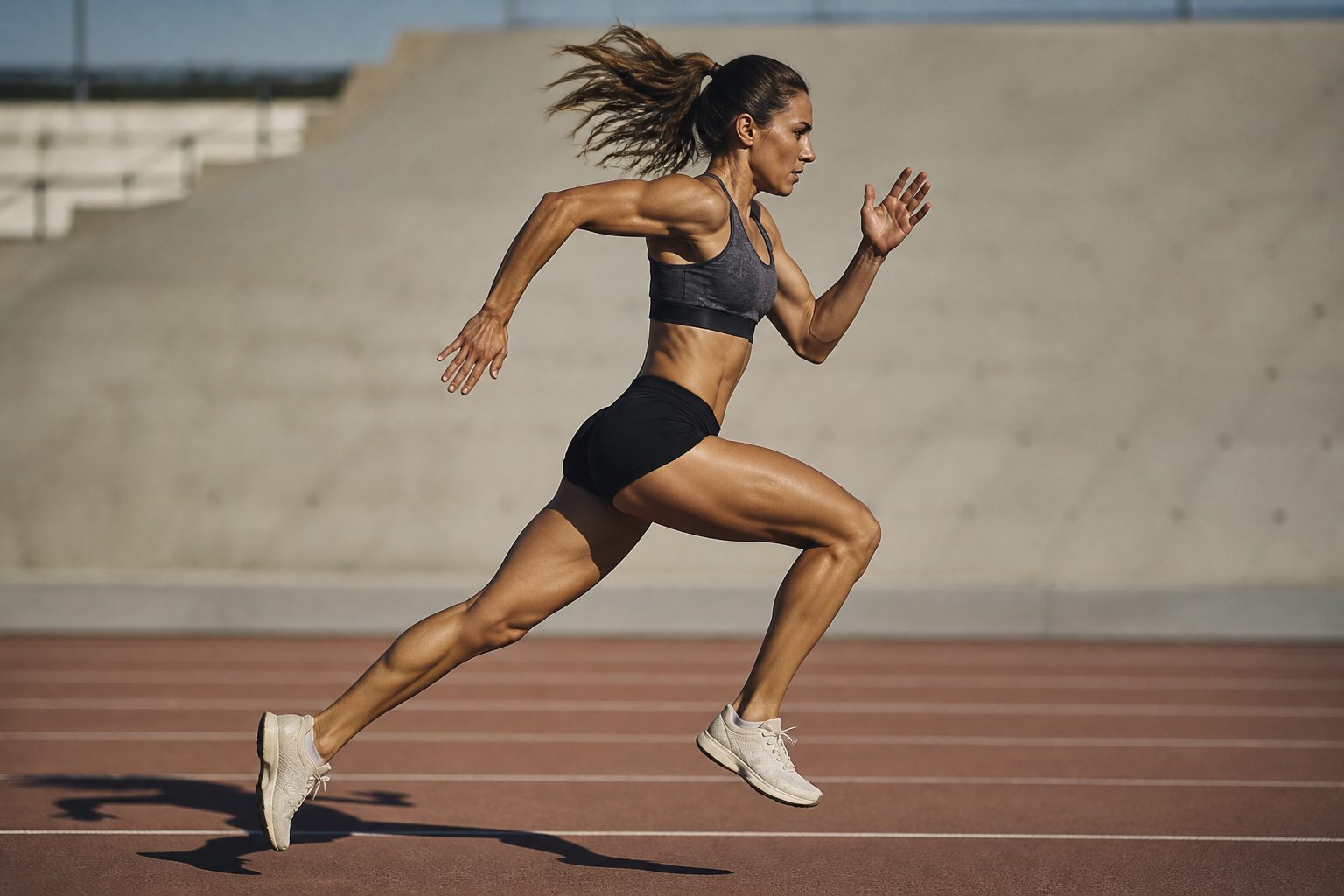
The peak moment in any sport lasts a few hundredths of a second — the ball leaving the boot, the swimmer’s reach at the wall, the runner’s full extension at the finish. Miss it and there is no second take. Commercial sports photography is the craft of being technically and mentally ready for that instant, every time, on demand. When a sportswear label, a gym, an event organiser or a sponsor hires us, they are buying that reliability: dynamic, sharp, emotionally charged images that make a viewer feel the effort. This guide explains how we get them.
Why sports photography lives and dies on shutter speed
Everything in action photography starts with freezing motion. A fast-moving athlete will smear into blur at the shutter speeds that work fine for a portrait, so we shoot fast — typically 1/1000s and faster, pushing to 1/2000s or beyond for sprinting, jumping or anything involving a fast ball. That crisp freeze, sweat suspended in mid-air, an expression of full exertion locked sharp, is what gives commercial sports photography its punch.
Fast shutter speeds eat light, so the trade-off is ISO. Indoor courts, evening events and covered stadiums force us up to high ISO values to keep that shutter speed, and we accept a little sensor noise as the price of a sharp frame — a slightly grainy but tack-sharp image always beats a clean blurry one. Knowing how far we can push a given camera before noise becomes a problem is part of the job.
Autofocus tracking, burst and catching the peak
A static subject is easy to focus on; an athlete charging toward you at speed is not. Modern continuous autofocus with subject tracking — the camera locking onto a body or a face and holding focus as it moves — is the technology that made reliable action work possible. We pair it with high-speed burst shooting, firing a rapid sequence through the moment so the peak action is somewhere in the run rather than down to a single lucky press.
But burst is a tool, not a strategy. Spraying frames blindly fills cards with junk and misses the moment as often as it catches it. The real skill is anticipation — beginning the burst a beat before the peak, because human reaction time alone is too slow to catch it. That is why understanding the sport matters as much as understanding the camera.
Reading the game to predict the shot
The best sports photography comes from photographers who know the sport. If you understand a game, you know where the ball is going, where the tension will release, which athlete is about to break, and where to point the lens before anything happens. We position for the play we expect, not the one already over.
- Shooting position is a decision made before the action: the angle that puts the athlete against a clean background, catches the face rather than the back, and aligns with the light.
- The decisive moment — the apex of a jump, the strain at the line, the celebration immediately after — is what we pre-visualise and wait for.
- Emotion sells. For brand work, the grimace of effort, the joy of a win and the focus before a start are often worth more than the technical action itself.
Panning: when blur is the point
Freezing everything is not always the goal. Sometimes a brand wants the visceral feeling of speed, and for that we use panning: a slower shutter speed with the camera tracking the moving subject smoothly through the frame. Done well, the athlete stays sharp while the background streaks into motion blur — an image that screams velocity in a way a frozen frame cannot.
Panning is a practised technique with a high miss rate, so we shoot plenty and keep the keepers. It works beautifully for cyclists, runners and motorsport, and it gives a sportswear campaign a dynamic, kinetic frame to sit alongside the crisp frozen hero shots. The mix of the two — frozen and flowing — gives a brand gallery range.
Gear and the brands that need it
Action work asks specific things of the kit. Fast telephoto lenses let us fill the frame with an athlete from a distance — essential when you cannot stand on the pitch — and their wide apertures both gather light and throw the background into a clean blur that isolates the subject. Bodies with fast, reliable autofocus and deep buffers for sustained bursts are the working tools of the genre.
The commercial briefs vary: sportswear labels want aspirational athletes and product in motion; gyms want their members training hard and looking strong; event organisers and sponsors want coverage that proves activation and feeds social. Sponsorship work in particular needs the brand visible in the action — logos, kit and signage caught alongside the peak moment. You can see how we handle dynamic commercial briefs across our portfolio, and sports work falls within our photography & content service.
Shooting sport in Singapore
Singapore offers a steady calendar for sports photography. The Singapore Sports Hub hosts everything from football to athletics; the streets fill with runners for events like the annual marathon; and there is a constant flow of community races, dragon-boat regattas, cycling events and gym and studio brand campaigns across the island. Each venue has its own light and access reality — an indoor arena under mixed artificial light, an outdoor track in the glare and heat of midday, a night race under floodlights.
The tropical climate adds its own demands: athletes sweat hard and fast here, which is honestly a gift for the genre — that visible exertion is exactly the energy brands want — but the heat and sudden rain mean we plan positions, protect gear and shoot the early or late light when an outdoor event allows.
Frequently asked questions
What shutter speed do you use for sports photography?
For freezing action we typically work at 1/1000s or faster, going higher still for sprinting, jumping or fast-ball sports. When we want a sense of speed instead, we deliberately drop to a slower shutter and pan with the subject so the athlete stays sharp while the background blurs.
Can you shoot indoor sports without disruptive flash?
Yes. Indoor venues mean low and mixed light, so we rely on fast lenses and a higher ISO to keep shutter speeds up rather than firing flash, which is often banned and disrupts athletes anyway. A little sensor noise is a fair trade for a sharp, natural-looking frame.
How do you capture sponsor branding in action shots?
We plan shooting positions and angles so kit, signage and logos sit naturally within the peak-action frames, giving sponsors usable proof-of-activation images. It is part of the brief from the start — we shoot the moment and the branding together rather than hoping a logo happens to be visible.
Got an event, team or sportswear campaign to shoot? Tell us what you’re staging and we’ll bring the sports photography that captures the peak moment and the emotion behind it.